200-minute Character study.
Throne

A quick one hour sketch, bashed out of a cube. Slapdash, ignoring geometry, then subdividing selectively. An uncomfortable-looking throne. I’d love to be able to mix geometric, hard-surface modelling with organic forms in a controlled way, like I know what I’m doing. Actually this might make a nice chess-piece…

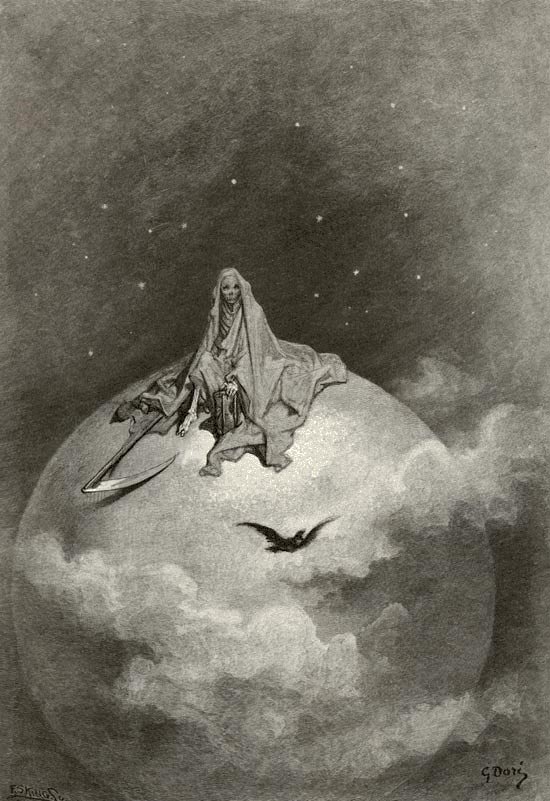
Totentanz


Two renders of a model after Doré’s “Death on the Moon“. For the purposes of album artwork I thought a mirrorball would make a funky substitute.

Animated gif after the click.
Neptune

Alright. A slightly over-worked and fussy image resulting from slightly obsessive tendencies. Not that I think its a totally unsuccessful image, though. I just found that the lines of movement and compositional focus seem to be incredibly difficult to keep track of when thinking of form , tone and colour. To somehow juggle these things and play them off each other seems to be the key, as incredibly difficult as that seems to me. Even in an image as fundamentally simple as this, with its muted palette and straight-on composition.
Cl-ick for progress animation.
Beer And Marsupials

Angry Koala. Separating elements and layers, coupled with the ease of making variants is addictive stuff. Also, it allows incredible tweaking flexibility. But the layer hierarchies! Coincidentally came across this image by JW Lewin yesterday. Which means that, the instant I hit “post”, I bookend the history of western Koala imagery.

Update: Image worked to the following variants for an open sub marketing comp hosted by the quare folk at Brewdog. Submission Unsuccessful.


Coeur

More tone separating and element balancing. The value of working with largely muted colour values interrupted by areas with a specific palette is that you’re starting from extremely simple beginnings, and each element is extremely manipulable. A special kind of coherence is easily reached. Aesthetically I suppose its a mixture of victoriana and jugendstil. My first formal training was in etching (chosen because I really liked the inked-line style of draughting from the plates of Dürer, Brueghel, Bosch, De’ Barbari and Callot to the gothic editorial and children’s/book engravings of Tenniel and, of course, Doré. Aaron Horkey and Vania Zouravliov have a great sensitivity to this chiselled, hard-edged, hierarchical type of composition.

. .
. ………
. .
. .
. .
. . .
. .
.
.
.
.
.
.
.
.
.
.
.
.
.
.
.
.
.
.
.
.
.
.
.
.
.. . . . . . . . . . . . .
 Pwwka.com